The social media litigation wave has crossed an important threshold.
For years, claims against major platforms were often framed as emerging, untested, or too novel to predict. That framing is getting harder to defend. Recent plaintiff-side wins, major verdicts, and expanding U.S. government enforcement show these cases are gaining real traction in American courtrooms. The first California bellwether verdict against Meta and YouTube gave plaintiffs something the litigation had not yet fully delivered: proof that a jury could accept claims tying platform design, compulsive use, and mental health harm together in a live trial setting. Around the same time, a New Mexico jury imposed $375 million in civil penalties against Meta in a separate child-safety and consumer-protection case, while Iowa’s attorney general filed suit alleging Meta falsely marketed Instagram as safe for children and teens.
That shift matters for law firms. It affects how these claims are valued, how aggressively plaintiffs may pursue them, how defendants assess settlement risk, and how quickly this space could expand across mass tort, class action, and public-entity filings. AAJ said in March 2026 that more than 2,400 cases were pending in MDL 3047, more than 800 were pending in the California JCCP, and more than 10,000 individual cases plus nearly 800 school district claims were pending nationwide.
The first plaintiff bellwether win changed the conversation
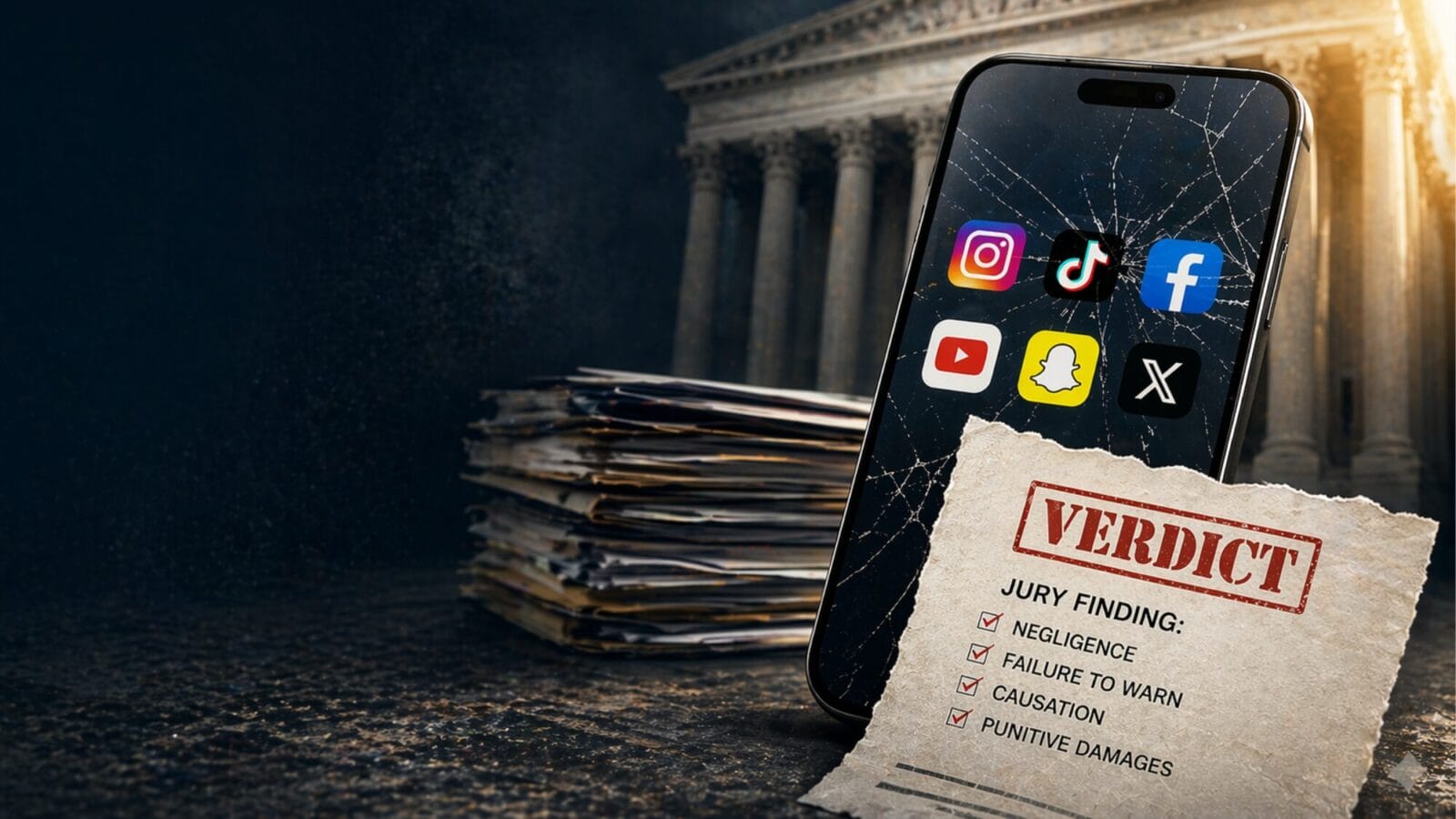
The California verdict is the clearest milestone yet in youth social media litigation. CBS News reported that the jury awarded $3 million in compensatory damages and $3 million in punitive damages, for a total of $6 million, after finding Meta and YouTube liable for creating products that led to harmful and addictive behavior by a young user. The jury also found the companies negligent and concluded they failed to adequately warn users about adverse effects on minors.
That matters because bellwether trials are designed to test legal theories, expert presentation, and jury reaction in ways that shape broader litigation. The California case arose from the JCCP proceeding running alongside federal MDL No. 3047 in the Northern District of California, and it was widely described as the first real jury test of these youth-addiction allegations against major platforms.
For plaintiffs’ firms, this is the strongest proof point so far that jurors may accept causation theories built around addictive design, mental health injury, and inadequate warnings. It also gives future plaintiffs a concrete record showing these claims can survive long enough to be tried and, at least in one case, win.
Massive verdicts are signaling serious exposure
The New Mexico verdict against Meta matters for a different reason. According to the New Mexico Department of Justice, the jury found Meta liable for misleading consumers about the safety of its platforms and endangering children, and ordered the company to pay $375 million in civil penalties under the state’s Unfair Practices Act. CBS also reported that the jury agreed Meta made false or misleading statements and engaged in “unconscionable” trade practices that took advantage of children’s vulnerabilities and inexperience.
Law firms should not collapse that case into the California addiction bellwether. They are distinct proceedings with different claims and procedural posture. But together they show that juries may be receptive to evidence that a platform knew of child-safety risks, minimized them publicly, and failed to take adequate corrective action. That combination significantly raises perceived exposure for defendants and increases pressure on settlement valuation across the broader litigation landscape.
Government enforcement is accelerating alongside private litigation
Another development firms should watch closely is the parallel rise in state attorney general actions. In April 2026, Iowa Attorney General Brenna Bird sued Meta, alleging Instagram was intentionally designed to addict young users while falsely claiming the platform contained only infrequent or mild harmful content, which helped support age ratings and safety representations to parents and teens. The suit seeks injunctive relief aimed at alleged deceptive statements, age ratings, and public safety assurances.
This matters because AG actions can do more than create headlines. They can expand the legal battleground into consumer protection and deceptive trade practices statutes, generate discovery and factual themes that private plaintiffs will study closely, and reinforce public narratives around corporate knowledge and youth harm. AAJ also said more than 41 state attorneys general had filed or joined social media addiction lawsuits as of March 2026, underscoring how broad this enforcement trend has become.
For plaintiffs’ firms, the practical takeaway is that the risk environment is no longer limited to private tort claims brought by families and individual users. It now includes coordinated private litigation and increasingly aggressive U.S. public enforcement.
U.S. policy pressure is reinforcing the same trend
The litigation trend is unfolding alongside broader U.S. policy pressure on how platforms design products for minors, disclose safety, and respond to youth harm. AAJ’s March statement tied the California verdict directly to calls for congressional action, including reform of Section 230 and passage of the Kids Online Safety Act. Whether or not Congress moves quickly, the signal is clear: litigation and public policy are increasingly reinforcing the same child-safety concerns.
This matters because it strengthens the same themes already surfacing in court: alleged corporate knowledge of harm, engagement-focused design choices, and gaps between public safety messaging and internal understanding of risk. For defendants, that creates layered exposure across private litigation, AG enforcement, and future legislative or regulatory pressure. For plaintiffs’ firms, it strengthens a broader narrative framework that juries are already beginning to accept.
Bellwether trials are only the beginning
The first bellwether did not close the book on these cases. It opened the next chapter. AAJ reported that additional California JCCP bellwether trials were scheduled for April 13, 2026 and June 8, 2026, and that the federal MDL was expected to begin in June 2026.
That means the litigation cycle is still developing. More rulings on expert admissibility, causation, platform design evidence, and trial presentation are still ahead. Those outcomes are likely to shape settlement frameworks and litigation strategy nationwide. Firms that assume the key story has already been written may underestimate how quickly this area could evolve.
The core legal theories are gaining traction
Across these developments, several recurring theories continue to define the litigation: addictive design and product liability, failure to warn, deceptive or unfair trade practices, and youth-safety misrepresentation claims. New Mexico’s case also shows how public nuisance theories may continue to emerge in parallel proceedings, with the state saying a separate bench-trial phase would address that claim and seek injunctive relief.
The significance is not that every theory has already won everywhere. It is that the overall theory bundle is moving from “novel and experimental” toward “credible and litigable.” The California verdict showed that design-based negligence and warning theories can resonate with a jury. The New Mexico and Iowa matters show that consumer-protection and youth-safety theories remain powerful and adaptable.
That opens the door to broader plaintiff-side activity, including school district lawsuits, mass tort expansion, and more aggressive use of internal platform documents to connect engagement mechanics with foreseeable harm to minors. AAJ’s reported volume of pending nationwide cases suggests firms should treat this category as active, not speculative.
What law firms should do now
Law firms evaluating this space should start with intake. Youth mental health claims tied to depression, anxiety, self-harm, compulsive use, or exploitation may represent a meaningful growth area as these cases gain legitimacy in front of juries. The first California bellwether win changes the screening calculus because it demonstrates that at least one jury accepted the central liability story.
Firms should also monitor MDL 3047 and the California JCCP closely. Those proceedings remain the most important battlegrounds for causation standards, expert admissibility, and settlement signals. With thousands of cases already pending, even incremental rulings may carry outsized strategic value.
State AG actions deserve equal attention. They may create new legal hooks, new public records, and new discovery pathways that can influence civil litigation even when the claims are not identical. Iowa’s case is a reminder that the government-enforcement side of this story is still expanding.
Finally, firms entering this space should prepare for high-stakes discovery. The central documents are likely to remain internal records about algorithms, recommendation systems, engagement design, age-related safety choices, and what companies knew about youth harm. Those issues were central enough in these cases that both AAJ and state enforcement authorities highlighted internal platform evidence as a major theme.
Bottom line
The social media litigation landscape is no longer defined by whether these cases can gain traction. That question has been narrowed considerably by recent U.S. verdicts and enforcement actions. The more important question now is how quickly these claims will scale and which firms will be prepared when they do.
The first plaintiff bellwether win in California, the $375 million New Mexico verdict, and expanding state attorney general enforcement all point in the same direction: social media harm litigation is becoming more credible, more active, and more consequential in the United States. For firms thinking about intake, positioning, and long-term growth, this is no longer a trend to watch from a distance. It is an emerging litigation category that is already proving itself in court.
At Summit Edge Legal, we watch shifts like these through the lens of law firm growth, case acquisition, and long-term market positioning. We are a complete client acquisition partner with decades of experience from top plaintiffs firms and Fortune 500 brand advertising, and we use AI analysis to continuously refine channels and optimize campaigns so firms get more consistent volume of higher qualified claimants. If your firm is evaluating how emerging litigation trends may affect intake and growth strategy, this is a space worth taking seriously now.